


Contract logistics is the long-term outsourcing of integrated supply chain operations including warehousing, inventory management, order fulfilment, distribution and transportation to a dedicated logistics provider. Unlike spot freight or one-off shipping arrangements, contract logistics involves structured service agreements tailored to a client’s specific operational requirements.
Businesses across automotive, retail, pharmaceutical and manufacturing sectors use contract logistics to reduce fixed costs, improve supply chain efficiency and scale operations without investing in their own infrastructure.
What Is Contract Logistics?
Contract logistics is the outsourcing of multiple, interconnected supply chain functions to a single logistics provider through a formal, multi-year agreement. The provider takes operational responsibility for warehousing, inventory control, order processing, distribution and transportation on behalf of the client.
The contract logistics definition extends well beyond basic storage or shipping. The provider embeds its operations into the client’s supply chain, often dedicating staff, warehouse space and IT systems exclusively to that account. Key performance indicators, service level agreements and continuous improvement targets govern the relationship.
A typical contract logistics engagement covers:
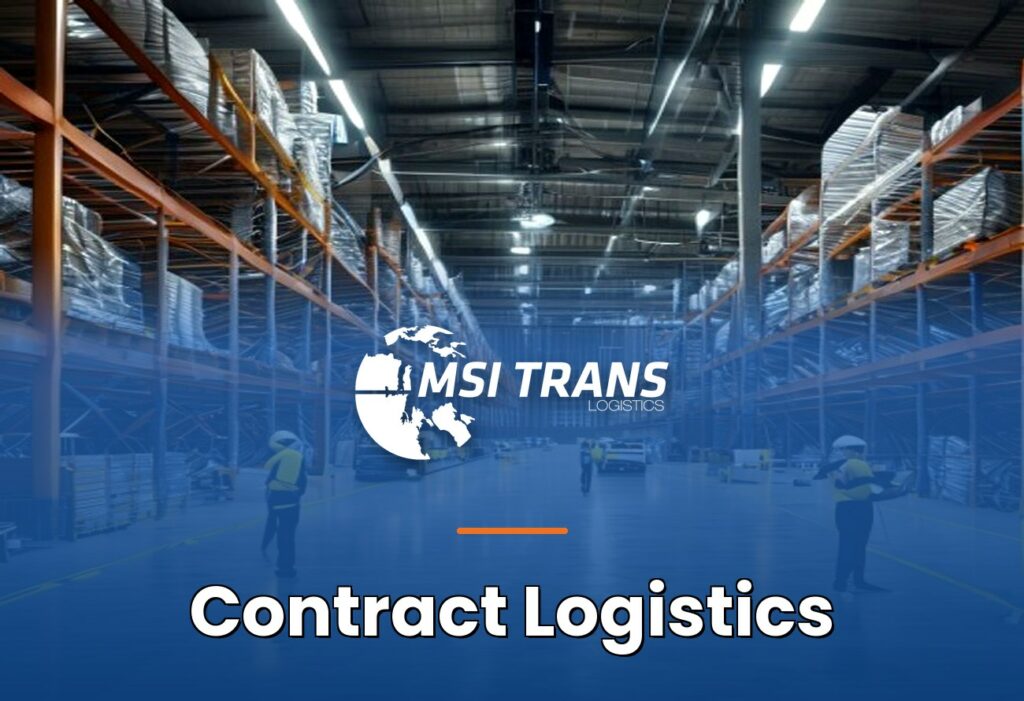
- Dedicated warehousing. The provider operates warehouse facilities configured specifically for the client’s product characteristics, throughput volumes and order profiles.
- Inventory management. Real-time stock tracking, demand forecasting integration and automated replenishment triggers keep inventory levels optimised across the supply chain.
- Order fulfilment. Pick, pack and dispatch operations execute against the client’s sales orders with agreed accuracy rates and turnaround times.
- Distribution and transport coordination. The provider plans and executes outbound deliveries using its own fleet or managed carrier network, optimising routes and consolidating shipments to reduce cost per delivery.
What Is the Difference Between Contract Logistics and 3PL?
The terms contract logistics and 3PL overlap significantly, creating confusion in the market. Every contract logistics arrangement qualifies as a 3PL service. However, not every 3PL engagement meets the contract logistics standard.
| Factor | Contract Logistics | Standard 3PL |
|---|---|---|
| Agreement duration | Multi-year (typically 3 to 5 years) | Short-term or transactional |
| Service scope | Integrated, multi-function operations | Often single-function (warehouse or transport) |
| Dedicated resources | Staff, space and systems assigned to one client | Shared resources across multiple clients |
| IT integration | Deep system connectivity (ERP, WMS, TMS) | Basic data exchange or manual reporting |
| Customisation | Solutions designed around client requirements | Standardised service packages |
| KPI governance | Formal SLAs with penalty and bonus mechanisms | Basic service commitments |
Contract logistics providers invest in client-specific infrastructure because the multi-year agreement justifies that capital outlay. Standard 3PL providers offer more flexibility but less depth. Businesses with complex, high-volume supply chains benefit most from the contract logistics model. Companies with simpler or variable logistics needs often prefer the lighter commitment of a standard 3PL arrangement.
Contract Logistics vs Freight Forwarding
Contract logistics and freight forwarding serve fundamentally different roles in the supply chain. Freight forwarding arranges the transport of goods from point A to point B. Contract logistics manages the entire operational ecosystem surrounding that movement.
A freight forwarder books carrier capacity, prepares shipping documents and coordinates customs clearance for individual shipments. The relationship is transactional. Each shipment operates as a separate booking with its own pricing and documentation.
Contract logistics absorbs the freight forwarding function into a much broader scope. The provider manages warehousing, inventory, order processing and distribution alongside transportation. Instead of booking individual shipments, the contract logistics provider plans and executes the client’s entire logistics operation under a unified service agreement.
Businesses that ship regularly across the same corridors often start with freight forwarding and graduate to contract logistics as their volumes grow. The transition replaces dozens of individual vendor relationships with a single operational partner who takes end-to-end accountability.
What Does a Contract Logistics Service Include?
A comprehensive contract for logistics services covers every physical and administrative function between the factory gate and the end customer. The exact scope varies by industry and client requirements, but the core components remain consistent.
- Warehousing and storage. Dedicated or shared warehouse facilities with racking systems, climate control and security infrastructure matched to the product category.
- Inventory management. Warehouse management system (WMS) integration provides real-time stock visibility, cycle counting, shelf-life monitoring and automated reorder alerts.
- Order fulfilment and pick-pack. Orders flow from the client’s ERP directly into the warehouse management system. Operatives pick items, assemble orders, apply labels and stage shipments for dispatch.
- Distribution and last-mile delivery. The provider coordinates outbound transport using owned fleets, contracted carriers or a combination. Route optimisation software minimises delivery cost and transit time.
- Value-added services. Co-packing, kitting, labelling, quality inspection, returns processing and light assembly operations add functionality beyond pure storage and transport.
- Transport management. Carrier selection, rate negotiation, shipment planning and freight audit functions centralise under the logistics provider’s control.
Benefits of Contract Logistics for Businesses
Outsourcing supply chain operations to a contract logistics provider delivers measurable advantages across cost, capability and scalability.
Fixed cost conversion tops the list. Building and operating warehouse infrastructure demands heavy capital investment. Contract logistics converts these fixed costs into variable operational expenses that scale with actual business volume. Companies pay for capacity they use rather than capacity they own.
Operational expertise transfers immediately. Contract logistics providers bring specialised knowledge in warehouse design, inventory optimisation, transport planning and customs management. Accessing this expertise through a partnership costs far less than building it internally.
Technology access accelerates without capital outlay. Modern supply chains depend on warehouse management systems, transport management platforms and real-time visibility tools. Contract logistics providers spread these technology investments across their client portfolio, giving each business access to enterprise-grade systems.
Scalability responds to demand fluctuations. Seasonal peaks, product launches and market expansion create sharp volume swings. A contract logistics provider flexes warehouse space, labour and transport capacity up or down without the client carrying idle resources during slower periods.
Risk reduction protects the operation. The logistics provider assumes responsibility for compliance, safety, staff training and operational continuity. Insurance, business continuity planning and regulatory adherence transfer to the specialist partner.
Contract Logistics by Industry
Different industries demand different supply chain configurations. Contract logistics providers adapt their operations to match the specific handling, compliance and throughput requirements of each sector.
- Automotive. Just-in-time and just-in-sequence delivery models require precise synchronisation between inbound component flows and production line schedules. Contract logistics providers operate line-side supply operations that deliver parts in exact production order.
- Retail and e-commerce. High SKU counts, fast order turnaround and seasonal volume spikes define retail logistics. Providers manage multi-channel fulfilment from shared distribution centres with same-day or next-day dispatch capability.
- Pharmaceutical. GDP-compliant storage, serialisation tracking and temperature-controlled handling govern pharmaceutical contract logistics. Every product movement generates an auditable record for regulatory inspection.
- FMCG. Fast-moving consumer goods operate on thin margins and high volumes. Contract logistics providers optimise pallet configurations, delivery frequencies and promotional stock handling to minimise waste.
- Manufacturing. Inbound raw material management, production line feeding and finished goods distribution form an integrated logistics chain. Providers coordinate machinery and equipment logistics alongside standard freight flows.
Haulage Contract Logistics and Transportation Management
The transportation component of contract logistics extends far beyond booking trucks. Haulage contract logistics integrates transport planning directly into the warehousing and distribution workflow.
A dedicated transport management function within the contract logistics framework handles carrier selection, route planning, load consolidation and performance monitoring. The provider negotiates annual rate agreements with carriers, securing consistent pricing that protects the client from spot-market volatility.
Logistics contracts for transportation typically specify vehicle types, departure frequencies and delivery windows. A manufacturer shipping finished goods from Turkey to distribution centres in the UK, Austria and Hungary benefits from scheduled weekly departures on fixed routes. This regularity enables precise production planning and reliable stock replenishment at destination warehouses.
Fleet utilisation optimisation reduces cost per shipment. The provider combines multiple clients’ freight into consolidated loads where possible, and schedules backhaul movements to avoid empty running. These efficiencies flow directly into the contracted rate structure.
How to Get a Logistics Contract
Securing a logistics contract follows a structured procurement process that evaluates operational capability alongside commercial terms.
The process starts with defining the scope of work. The business documents its current logistics volumes, warehouse footprint requirements, transport lanes, service level expectations and growth projections. This operational brief forms the foundation of every subsequent evaluation.
Next, the business issues a Request for Proposal (RFP) to qualified contract logistics providers. The RFP includes volume data, service specifications, IT integration requirements and commercial evaluation criteria. Providers respond with detailed operational proposals and pricing models.
Site visits and operational audits verify that the provider’s physical infrastructure matches their proposal. Evaluators inspect warehouse facilities, meet operational teams and review existing client case studies. Reference checks with current clients reveal service quality beyond what proposals can demonstrate.
Commercial negotiation finalises pricing, contract duration, KPI frameworks and exit terms. Most logistics service contracts run three to five years with annual rate review mechanisms and performance-linked bonus or penalty structures.
How to Choose Among Contract Logistics Companies
Selecting the right contract logistics company determines whether the outsourcing delivers its promised benefits. Several evaluation criteria separate capable providers from those likely to underperform.
Operational infrastructure matters first. The provider must possess warehouse capacity, fleet resources and technology platforms that match the client’s volume and geographic requirements. A provider strong in domestic UK distribution may lack the cross-border capability needed for European supply chains.
Industry expertise reduces implementation risk. Providers with proven experience in the client’s sector already understand the compliance requirements, handling protocols and service expectations. This familiarity shortens the onboarding period and reduces operational errors during transition.
Technology capability enables visibility. Modern contract logistics depends on WMS, TMS and real-time tracking platforms. Providers must demonstrate system integration capability with the client’s ERP and order management platforms.
Financial stability protects the long-term relationship. A multi-year logistics contract requires a provider with the balance sheet strength to invest in dedicated infrastructure and absorb short-term volume fluctuations without degrading service quality.
Why Choose MSI-Trans Among Contract Logistics Companies?
MSI-Trans delivers contract logistics solutions anchored in deep European road transport capability. The company’s operational model integrates dedicated transport services with supply chain coordination across the busiest international freight corridors.
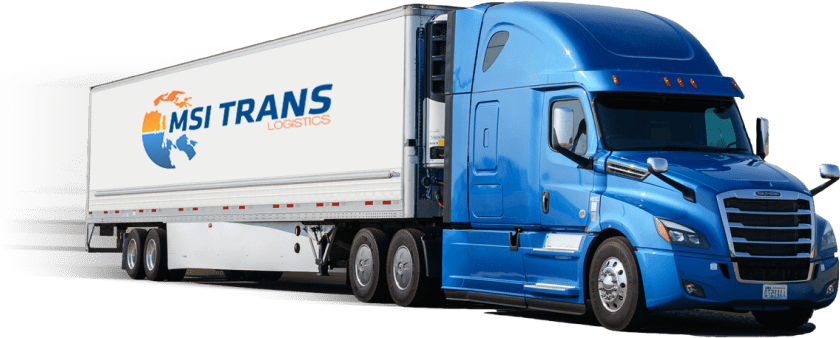
Extensive fleet capacity. The 4,300+ vehicle fleet provides both FTL and LTL capacity without dependency on third-party carriers. Clients secure guaranteed vehicle availability on their contracted routes, eliminating the spot-market uncertainty that disrupts supply chain planning.
Multi-temperature transport capability. Contract logistics clients shipping temperature-sensitive goods access dedicated refrigerated fleet capacity. The frigo and termo fleet maintains controlled conditions from deep freeze through to ambient throughout European transit.
In-house customs and compliance. MSI-Trans processes all border documentation internally on its core Turkey to UK, Austria and Hungary corridors. Direct customs authority relationships reduce clearance times. This integrated approach prevents the cargo delays that outsourced customs brokerage frequently causes.
Scheduled corridor operations. Weekly departures on fixed European routes enable precise supply chain scheduling. Contract logistics clients plan production and distribution cycles around reliable transit windows rather than ad-hoc truck availability. Learn why businesses choose MSI-Trans for dedicated logistics operations.
For a contract logistics proposal tailored to your supply chain requirements, contact the MSI-Trans operations team with your volume projections, route details and service specifications.
Frequently Asked Questions About Contract Logistics
What is contract logistics?
Contract logistics is the long-term outsourcing of integrated supply chain operations to a dedicated provider. The scope typically covers warehousing, inventory management, order fulfilment, distribution and transportation under a multi-year agreement.
What is the difference between 3PL and 4PL logistics?
A 3PL provider operates logistics functions directly, managing warehouses and transport. A 4PL provider acts as a supply chain integrator, coordinating multiple 3PL providers and managing the entire logistics network on behalf of the client without owning physical assets.
What is a contract logistics example?
An automotive manufacturer outsources inbound parts warehousing, just-in-time production line delivery and finished vehicle distribution to a single logistics provider under a five-year contract with dedicated staff and facilities.
What does contract logistics and warehousing cover?
Contract logistics and warehousing covers dedicated storage facilities, inventory management, order processing, pick-pack operations and outbound distribution. The provider manages all warehouse functions under agreed service levels and KPI targets.
What are the typical contract durations in logistics?
Most contract logistics agreements run three to five years. Shorter contracts of one to two years suit initial trial periods. Longer agreements of five years or more apply when the provider invests heavily in client-specific infrastructure.
Does MSI-Trans offer contract logistics services across Europe?
Yes. MSI-Trans provides integrated transport and supply chain solutions across European corridors connecting Turkey to the UK, Austria and Hungary. The 4,300+ vehicle fleet supports both FTL and LTL operations under long-term service agreements.
How can businesses request a contract logistics quote from MSI-Trans?
Contact the MSI-Trans operations team with your annual freight volumes, primary origin and destination points, required service scope and any special requirements such as temperature control or customs brokerage.